A deeper look into behaviour in children, nervous system patterns & the power of gentle chiropractic care
Have you ever watched your child move through the world and felt like their body was operating three steps ahead of their mind?
They struggle to sit.
They have outbursts that seem more than just tantrums.
They constantly need stimulation – to be doing something, having something.
And despite their need for stimulation, they seem to be overwhelmed.
Parents often describe it like this:
“It’s like they never stop, it’s draining”
“They can focus on the things they love, but everyday tasks feel impossible.”
“They’re either full-speed-ahead or melting down – there’s no in-between.”
“I know they’re not being ‘naughty’, they just can’t settle.”
“We have tried changing the diet, the routine, sensory toys, etc., but nothing seems to be making a profound change”
This blog is for those parents.
It is not to label children, diagnose conditions, but to explore your child’s behaviour through another lens.
To understand what their behaviour is telling us about the nervous system and how we can support better regulation, ease and calm in our children with a drug-free, holistic, neurologically-focussed approach. It is my passion to share this information and care for our younger population. I hope you find this blog useful. Let’s dive into it.
Behaviour is Biology in Action
Behaviour is not random.
Behaviour is highly intertwined with our physical and physiological state and capacity.
What do we mean by this? Your body’s internal state plays a dominant role in how your child (and anyone for that matter) engages with the world.
Behaviour is an output – a response – dependent and reflective of what is happening internally. Internally, the nervous system must have awareness of what is going on in the body. A nervous system that is lacking in internal stimulation (sensation) is in a state of threat because it is unaware of what is going on.
What does this mean? How is behaviour influenced: If the nervous system is in a state of threat, it is NOT going to prioritise or be able to manage an external input, e.g an instruction – this may lead to overwhelm-type behaviours. Additionally, if the system is in a state of threat, then it is going to try to seek safety through stimulation, e.g. consistent need to eat (stimulates the central tissue – oseophagus), excessive physical action such as forceful fighting, fidgeting, shouting, screaming, etc.
External Input -> Nervous System (regulated or dysregulated) -> Output
OR
Lack of internal sensation –> lack of safety -> conscious stimulation seeking
If the state by which the input is internalised by the body. You see if the internal state of the body is in a chaotic, dysregulated external input cannot be processed, and internal input is craved
That is important.
We describe it to our parents like this: It’s like trying to put complex instructions into an old computer that cannot keep up…the computer is not going to function properly or even have the capacity for advanced features – it is going to freeze, jump, or crash out.
More and more children may be operating from an “old computer”, poor internal processors. These computers cannot do as much and have less capacity. We want to upgrade the processor (the nervous system) so the computer has more capacity for action and can manage more clicks, more instructions, etc.
Our goal is to upgrade the computer.
When a child:
- Can’t stop moving
- Fidgets constantly
- Seems “wired” or hyper-alert
- Struggles with stillness or focus
- Reacts impulsively or intensely
- Seeks heavy pressure, jumping or crashing play
- Has big emotions that switch like a light
Common ways input can be found in movement, speech, collisions (think: all these activity creates tissue activation:
- Movement – such as
- running
- constant fidgeting
- tic-like behaviours
- all to find a sense of sense because movement creates input, tissue activation
- The voice – such as
- Shouting
- Screaming
- Straining
- creates a means of spinal bracing and vibration. Try shout or speak without bracing your body in some way (tissue bracing). The vibration provides stimulation to the tissue; this may also be why vibration can be soothing and stimulating to our children with poor nervous system function.
- Collisions such as
- Fighting and hitting
- Deep Pressure
- Running into objects
- creates impact, activation that the body can use to find a sense of input.
Midline tissue activation (dependent on spinal function) = internal input.
Internal input = Safety
These behaviours are the brain’s attempt to find a greater sense of self.
Our nervous systems need to have high quality input and if it has not got it it will do whatever it can to find!
This is why sensory toys and equipment are fantastic tools our parents have found success with. Our goal is to support the foundations of nervous system health alongside the therapies you may have in place for your little ones.
When a child seeks input e.g. movement, shouting, they’re often not avoiding calm – they are looking for nervous system input to find a sense of calm.
That is important!
Sympathetic Dominance – When “Go Mode” Becomes the Default
Children who struggle with focus, stillness, impulse control or emotional regulation are often operating from a dominant sympathetic state.
Sympathetic state = alert, fight-flight-freeze Parasymapthetic = calm, centered, “rest-digest”
A sympathetically biased state = survival mode
Fast. Reactive. Scanning. Ready.
Sympathetics are not bad. They are there for a reason. It is when there is a consistent sympathetic bias where we run into problems
The sympathetic nervous system are fantastic for running from threat, climbing trees, running, but exhausting when it becomes the only state the body recognises.
Proper tone in both the sympathetic and parasympathetic nervous system is important. Even in sympathetic active there should be a degree of parasympathetic tone in the nervous system.
We often describe it as a balancing act in a car between the gas pedal (sympathetic) and parasympathetic (brake). It is not about one of the other, it’s about both.
When the body does not understand what is happening internally, the external environment is perceived as threatening, more urgent, more unsafe – and this reflects in behaviour.
Abnormal Behaviour is the symptom, the expression, the feedback Signs sympathetic dominance may be present:
| Child Behaviours We See |
| Constant movement; difficulty sitting still |
| Impulsivity, speaking before thinking |
| Fidgeting, chewing, spinning, crashing |
| Bedtime battles, trouble relaxing |
| Meltdowns when asked to sit, listen, wait |
This is not the average “bad behaviour” that they can get up to – the cheeky mischief, the playful acts. It’s different and chances are if you’re reading this you are aware of the difference.
When the brain is biased towards sympathetic tone, the nervous system is in a state of physiological high alert, meaning that it is not prioritising focusing, emotional control, or higher executive function.
You can’t focus and sit still while your nervous system thinks you’re running from a lion.
Parasympathetic Regulation & Vagal Tone – The Key to Autonomic Calm
As we mentioned, the opposite to “go mode” is the parasympathetic system – the arm responsible for rest and repair, social connection, emotional safety and stillness.
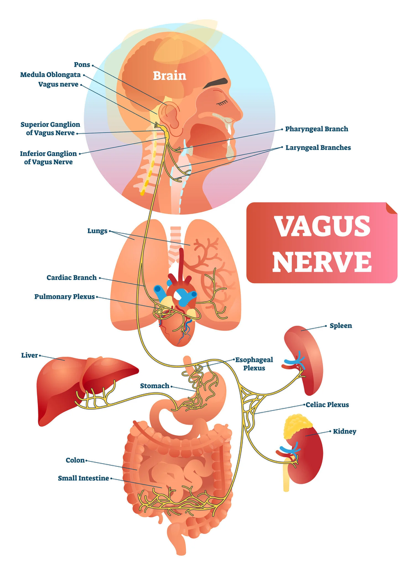
A lot of people think ‘vagus nerve’ and look to temporarily stimulate it – some of these things your child may intuitively do:
humming, banging chest, chanting/panting, gargling, massage/stimulation points e.g. ear, scalp etc.
These are 100% useful tools. However, as they are temporary stimulations, they don’t consistently ensure vagal tone is up-regulated, consistent and stable.
We want consistent vagal tone to support a balanced autonomic nervous system. How does this relate to your child’s structure? Let’s dive a little deeper.
The Spinal System
When we talk about vagal tone a big component of this is bringing proper coordination and stability back to the spine.
I am going to refer to this as the spinal system or midline because at Roots, we do check the entire cranium, spine and pelvis (can be called the midline) as these can all impact a person’s normal neurological function profoundly with intricate connections to the spine.
The entire body must operate as one co-ordinated system – all the vertebrae moving in sync, the skull and pelvis working together.
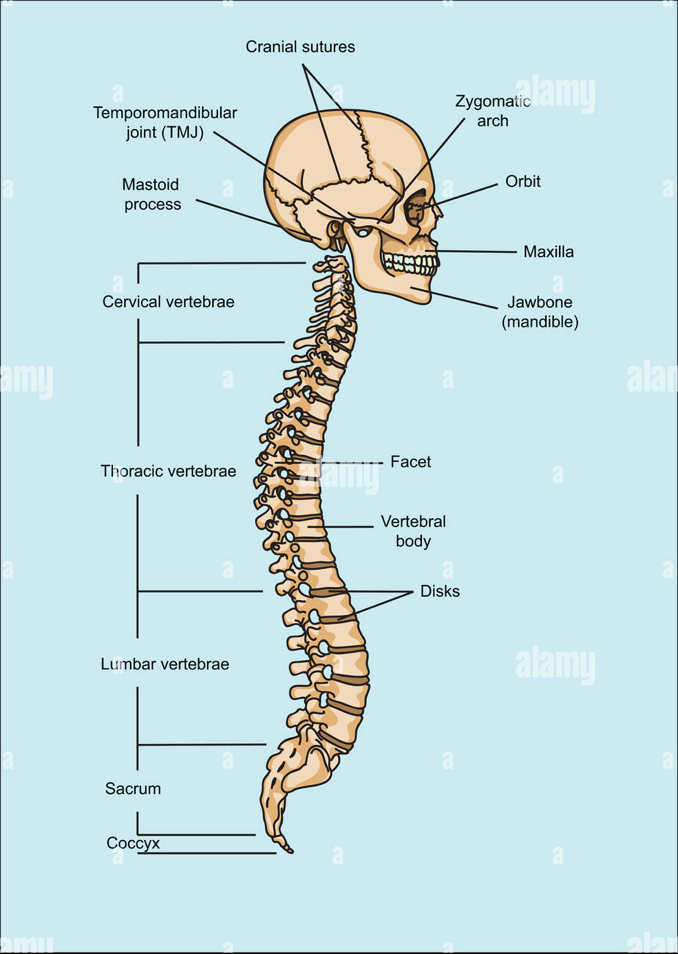
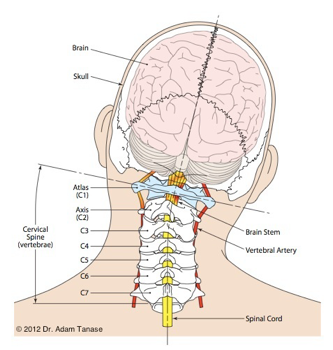
A specific mention to where the neck and spine (known as the cranio-cervical junction) meet plays a crucial role in nervous system function.
Blood Flow
Upper cervical misalignment, poor cranio-cervical stability, and a loss of cervical curve in this region can alter the blood flow between the brain and body. This includes the cerebellum (the “old brain”), which is responsible for muscle tone and coordination in the body. The cervical spine is crucial to stabilise in his regard.
Mouth Breathing
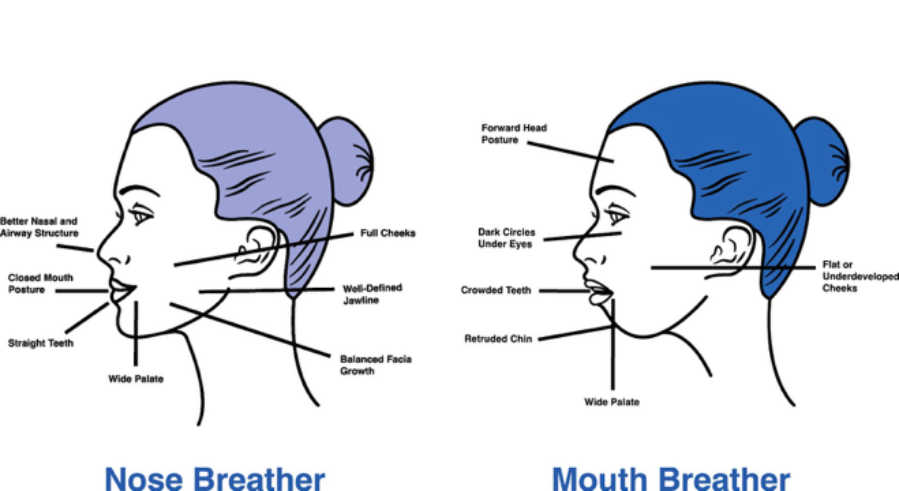
Poor cranio-cervical stability can also lead to mouth breathing that can result in inflamed tonsils, a narrow palate, sleep difficulties that have ALL been linked to altered behaviour in children of all ages. Reduced oxygen to the brain, poor grounding in the body and low spinal stability may be involved mechanisms.
You may see this in a tired look, small smile, poor face diction, rounded shoulders, poor teeth spacing, nighttime snoring, small frame etc.
Midline Tone and Interoception
Interoception is the ability for your body to understand exactly what is going on inside itself – little spoken about, really important. It is dependent on high quality signals going into the nervous system 24/7.
Poor midline tone may reduce the signalling going to the nervous system – many life functions rely on proper midline tone: spinal cord function, movement of crucial fluids, visceral/organ functioning.
Proper spinal function = better signalling to the nervous system
Better signalling = better information to the brain = better sense of self (interoception)
Safety signalling = better parasympathetic tone and reduced internal stress.
Normal neurological function is crucial to support our children and their proper development. Chiropractic can facilitate the potential for change that was always there but never facilitated.
Where Chiropractic Fits – Supporting Regulation, Not Treating Conditions
Chiropractic focusses on supporting normal, coherent nervous system function by assessing, measuring and supporting proper nervous system function by improving neurological relationships in the body – specifically by adjusting the spine.
When vertebrae are misaligned (upper cervical spine) or moving in an unco-ordinated fashion (full spine) this has the potential to:
- reduce sensory information into the brain and nervous system
- alter fluid flow (blood, lymph, CSF – all of which can impact the function of neural tissue)
You can relate it to walking in a room when it is pitch black. You cannot see (lack of clarity) but you still need to navigate the room (environment) – you walk slower, more tentative, more anxious.
Gentle, specific, Chiropractic care aims to improve:
- Interoceptive awareness (“What is going on inside me?”)
- Neurological clarity (less chaotic signals)
- Parasympathetic/vagal tone (less ‘survival mode’)
Thus a greater sense of safety and ease in the system, more robust, adaptive and resilient self.
We don’t teach stillness.
We don’t force behaviour.
We support the system that influences behaviour. When the nervous system feels safe – children often naturally slow down.
How We Measure Vagal Tone & Nervous System Stress – INSiGHT Scans
This is where our approach becomes beautiful – we don’t guess, we measure.
Inside our office, we use INSiGHT Nervous System Scans to map and track how your child’s nervous system is functioning and tailor their care to their specific nervous system needs. Not symptoms but nervous system function.
These scans help us understand the tone of the autonomic nervous system using:
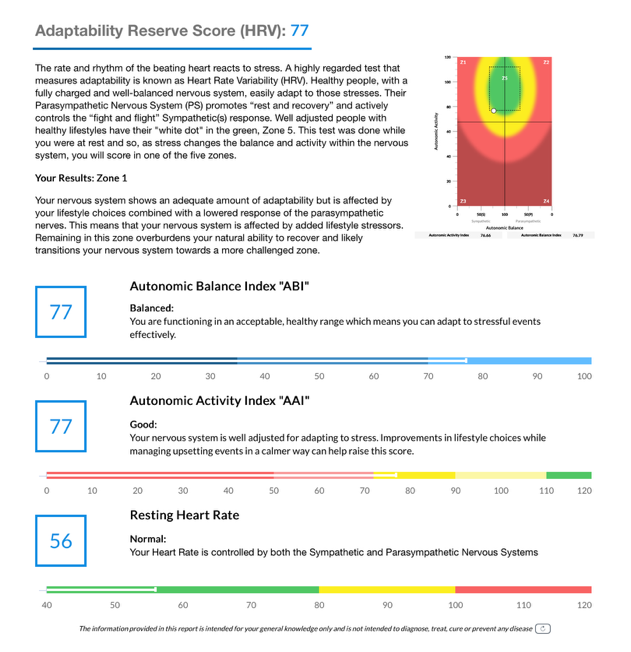
1. HRV (Heart Rate Variability)
A gold-standard indicator of vagal tone & adaptability.
Lower HRV often reflects stress overload or sympathetic dominance.
Improving HRV is linked to better regulation + calmer behaviour.
2. EMG (Muscle Activity Scan)

Measures electrical activity in the muscles around the spine demonstrating tension patterns
High or low activity can mean stress around the spine that can reflect excessive energy expended to regulate posture and movement, placing extended exhaustion on their system.
3. Thermal Scans
Measures the temperature difference adjacent to each vertebra
Either side of the spine contains cells that control blood vessel dilation and constriction (a function which is controlled by the autonomic nervous system). When there is stress in the spine, these blood vessel constrictions can change -> alter the temperature on either side of the spine -> indicate altered autonomic nervous system function.
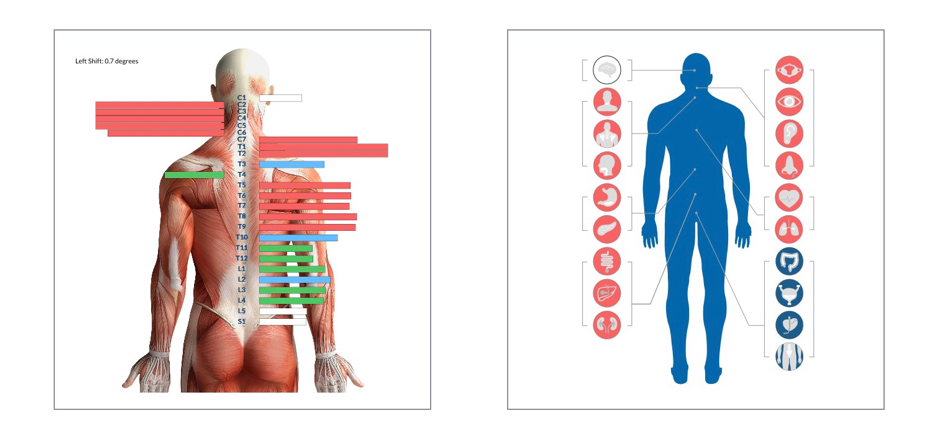
Together, these scans build a picture of how your child is coping – not symptomatically , but neurologically.
The scans allow us to:
- Identify stress patterns affecting behaviour
- Customise their chiropractic care plan
- Track improvements over time
- Help parents see what their child is experiencing internally

What Shifts We Commonly See With Care
Over time, many parents report:
- Calmer behaviours
- Better ability to focus without constant movement
- Fewer meltdowns or emotional spikes
- More stillness when needed
- Easier sleep and time during transition periods
- More social connections and listening capacity
- More joy, curiosity and confidence
Chiropractic care for a coherent internal state
Chiropractic care doesn’t treat behavioural diagnoses. Instead, it focuses on helping your child’s nervous system become more regulated and resilient, so their natural ability to heal and adapt can shine through.
When a child feels safer internally, their behaviours and overall health often shift as a natural by-product. Each child responds differently – some changes are quick, others are slower or more subtle – which is why we track progress over time and focus on reducing nervous system stress rather than chasing symptoms.
Many families choose this gentle, drug-free approach because it supports their child naturally. If you notice big emotions, constant movement, or signs that your child’s nervous system may be in need of help, chiropractic may offer meaningful neurological support.
We want to empower health, naturally with Chiropractic.
I hope this provided value to you. It is common after reading that you may have some questions, thoughts or queries. If you want to explore these then please reach out – we’re here to help.
Kindest regards,
Morgan
It is our mission to support and facilitate optimal neurological health in our community with Chiropractic care – for individuals, families, all ages from all ways of life. We understand that with better health internally facilitates the greatest change in all aspects of life externally. If you, or someone you know, would benefit from Chiropractic care please help us on our mission and share our media and Practice details.