When most people think about their health, they hyper-focus on chasing symptoms. But the truth is this: symptoms do not reflect if your body is functioning optimally or not…
Think about it:
❌Symptoms can be a sign that there is tissue damage, e.g. broken leg -> pain
❌Symptoms can be a sign that you need to avoid a particular movement, e.g. moving like X causes said discomfort, pain or feeling sluggish
✅Symptoms can be a sign that you need to change a behaviour, e.g. you have worked intense 12-hour shifts daily for a week -> feeling fatigued to encourage you to rest
✅Symptoms can be a sign of “balancing” out physiology, e.g. vomiting due to food poisoning, nausea from excessive medication intake etc.
Symptoms can indicate several different things that the body is doing. The body has incredible intelligence within it, symptoms are feedback from the body – they do not necessarily dictate your current health state or function.
Throwing up bad food for example, is a bad symptom but actually a necessary action for the body to rid of poison…imagine we stopped the body vomiting… the poison would not leave the body as optimally! But vomiting being an unpleasant experience, people can initially misunderstand this as an “unhealthy response”, when in reality we know it is a healthy response from the body.
The point being is that symptoms, the feedback from the body, is part of the health story but it can be very difficult to tell why we are experiencing particular health problems.
This is where Chiropractic is different we acknowledge that the body is intelligent and has natural physiological processes that help us heal and recover naturally from trauma and injury we aim to work with this and restore normal intelligent processes in the body so the body can heal naturally rather chasing symptoms we help the body do what it needs to do best.
This is where the nervous system comes in because what’s happening at the level of your nervous system tells a far deeper story…
Your nervous system is the master controller of your entire body. It governs how well you adapt, how well you recover, and how efficiently your body manages everything from breathing and digestion to posture and muscle tone. But here’s the challenge – your nervous system is not something you can directly see. For many people, their nervous system spends more time in a stress-dominant, “survival mode”, unsupportive state than they realise.
That’s why neurological scanning has become such an important part of modern chiropractic. They give us a window to how you are functioning, adapting, and organising, so that your care can be personalised to your current state of health – not guessed, not assumed, and not based solely on symptoms.
In this blog, we’ll explore what neurological scanning is, why tracking matters, what “stress physiology” actually looks like, and how the three Insight Scans – Heart Rate Variability (HRV), Surface Electromyography (sEMG), and Thermographic scans – help us understand your body’s baseline and progress.
Why We Look at the Nervous System First
Every experience your body has, physical, emotional, or chemical, your nervous system must adapt to – whether that is chronic adopted positions at work, mentally stressful relationships, intense emotional experiences, or regular consumption of inflammatory foods. The nervous system keeps you adapting to the ever-changing environment.
For the sake of this blog, I’d like to discuss the autonomic nervous system. This is the aspect of the nervous system that plays its role in unconscious action e.g. the heart beating, lungs breathing, the bowels clearing, the immune system functioning/ We can simplify the system into two general modes:
1. Survival Mode (Sympathetic Dominance)
This is your “fight, flight, or freeze” physiology. It’s designed to protect you.
In this state:
- Your heart rate increases
- Breathing becomes shallow
- Digestion slows
- Immune regulation shifts
- Muscles tighten for protection
- Your brain prioritises alertness over calm focus
- Your body allocates energy to immediate survival – not long-term wellbeing
Survival mode is not inherently bad; it’s essential. However, the problem comes when the nervous system gets “stuck” there, even when the threat is gone (if there was ever threat to begin with).
Modern life, e.g. poor eating habits, screens, deadlines, noise, lack of sleep, old injuries, unresolved trauma patterns, means that many adults and children spend far more time in sympathetic overdrive than their bodies were ever designed for.
2. Regulation Mode (Parasympathetic Dominance)
This is your “rest, digest, heal, and grow” physiology.
In this state:
- Heart rhythm becomes more adaptable
- Breathing deepens
- Digestion becomes efficient
- Immune function is regulated more effectively
- Muscles relax
- The brain shifts from reactivity to regulation and learning
- The body allocates energy to growth, repair, and long-term health
These two states are constantly shifting throughout the day, which is normal and healthy. Having the capacity to shift between these states is a sign of a robust, adaptable nervous system. However, the quality of that shift (and how easily your system transitions between them) is an enormous indicator of health and adaptability.

How does this relate to Chiropractic? Well, we can measure your nervous system adaptability objectively and track your progress over time. This is crucial to help your nervous system heal and adapt – pain, aches, poor mobility, inability to do daily function require a proper functioning nervous system to change.
Why We Track Nervous System Patterns Over Time
Neurological scans allow us to do three important things:
1. Understand your baseline physiology
Before recommending care, we must know the state that your nervous system is biased towards and how this matches with your current presentation. This allows your care plan to be tailored rather than generic.
2. Measure progress – not symptoms
Symptoms can change quickly, randomly, and not be consistent indicators of what your baseline function and health is – especially when your nervous system is not functioning at its best.
Scans let us observe and analyse
- Shifts in nervous system adaptability and your physiological state
- Improvements in muscle tone next to the spine
- Better symmetry in muscle activity
- More efficient neural communication
This provides useful objective feedback that can guide your care plan.
3. Make care more precise and personalised
No two nervous systems respond the same way.
No two bodies adapt the same way.
And no two care plans should be identical.
By tracking your scans at regular intervals, we can adjust recommendations to support what your body actually needs at each stage of care to ensure that your body is in a state where it can begin to, and continue to, heal naturally.
What Insight Scans Are (and Aren’t)
Insight Scans do not diagnose conditions, and they’re not used to treat disease or pain. Instead, they are a non-invasive way of measuring how well your nervous system is:
- Regulating, adapting and managing stress
They give us a detailed picture of your nervous system’s baseline functional physiology. This way we can build a coherent picture of your health at the a foundational level.
Additionally, because they are non-invasive, painless, and extremely quick, they are suitable for adults, children, babies, athletes, pregnant mums – anyone with a nervous system.
The Three Insight Scans and What They Tell Us
Now that we’ve set the stage, let’s break down the three major components of the Insight Scanning system and what each one measures.
1. Heart Rate Variability (HRV) – How Adaptable Is Your Nervous System?
HRV is one of the most researched markers of nervous system adaptability.
It measures the variation between your heartbeats – not the heart rate itself, but the rhythm.
A healthy nervous system has flexibility – it is not static because your life is not static.
The beat-to-beat changes shift depending on your internal and external environment
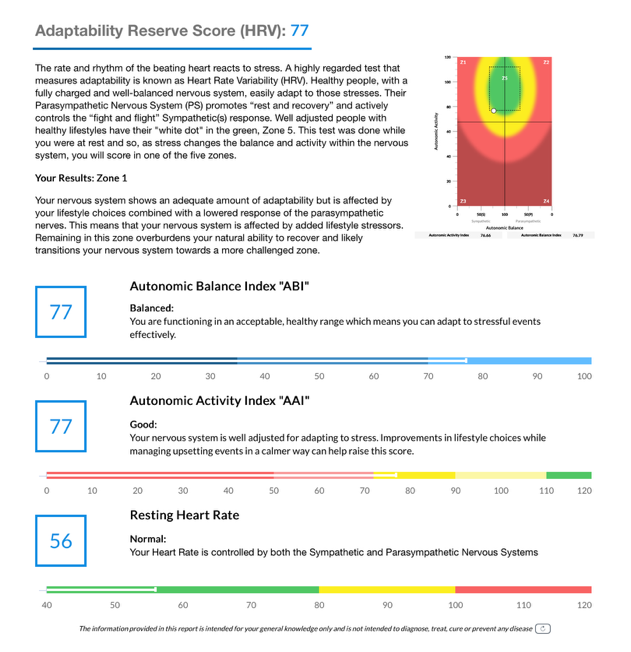
What HRV tells us:
- How well you handle stress
- Whether your body is leaning toward survival mode or regulation mode
- Your overall physiological adaptability
- How much energy your nervous system is using
- Whether your system is recovering or burning out
- The balance between sympathetic (fight/flight) and parasympathetic (rest/digest) activity
Why this matters for your health:
Your heart rhythm reflects the tone of your autonomic nervous system – the same system that can influence:
- The tone of your muscular system
- Your experience of pain
- Immune system balance
- Digestive efficiency
- Hormonal rhythms
- Emotional regulation
- Sleep quality
- Cardiovascular resilience
- Recovery after stress or exertion
A lower HRV indicates the system is working harder than it should to keep up.
A more adaptive HRV pattern shows the system is flexible and responsive.
When HRV improves over time during care, it often reflects increased resilience, better rest-digest capability, and improved physiological organisation.
2. Surface Electromyography (sEMG) – How Good is Your Spinal Muscle Tone?
sEMG measures the energy and activity of the muscles along your spine. These muscles are directly linked to how the nervous system organises posture, support, and protective patterns.
In simple terms, sEMG tells us how much effort your body is using to hold itself upright.

What sEMG reveals:
- Are certain muscles overworking? (such as the red and green lines above)
- Are others underworking? (Such as the yellow lines above)
- Is your body using too much energy for simple tasks like standing and sitting?
- Are there potentially patterns of compensation from old injuries or stress?
- Does the system show signs of tension, guarding, or imbalance?
Muscles don’t tighten at random , they tighten because the nervous system is prioritising stability or protection – making the best of the situation at hand
Why this matters:
Chronic tension in spinal muscles can influence:
- Global posture
- Breathing mechanics
- Head and neck awareness
- Pelvic balance
- How stress/trauma is stored in the body
- Energy levels (overuse of muscles = energy drain)
When sEMG readings become more balanced during care, it often reflects improved motor control, better posture support, and a reduction in patterns of overuse or compensation.
3. Neurothermal Scan – How Balanced Is the Nerve Supply Along the Spine?
Thermographic scanning measures the heat patterns along either side of the spine. Temperature variations can indicate variations in autonomic nerve activity.
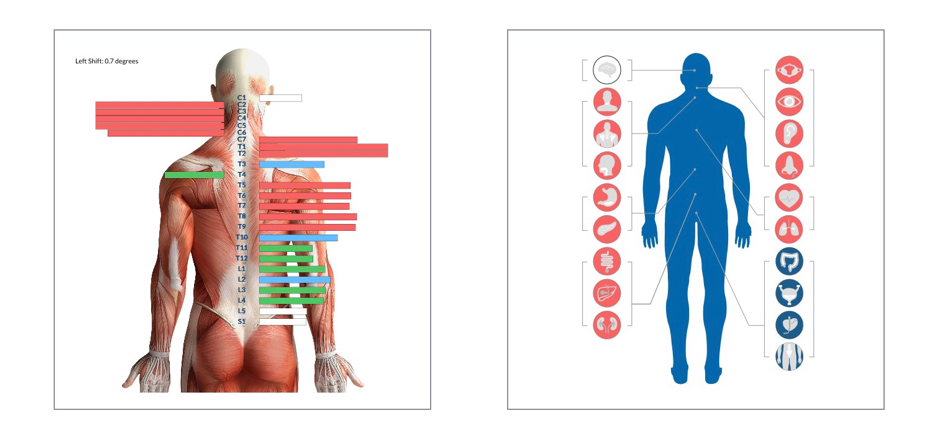
Because autonomic nerves regulate:
- Blood vessel tone
- Organ function
- Glandular activity
- Immune activity
- Tissue healing
…changes in thermal patterns can show how well different levels of the nervous system are regulating.
What thermal scans help us see:
- Areas of heightened stress physiology
- Regions where the system may be overloaded
- Patterns linked to full health function as it relates to musculoskeletal, digestive, respiratory, or other organ-related stress responses
Why this matters:
Thermal imbalance can reflect how the nervous system is communicating with different regions of the body.
While it doesn’t diagnose an organ problem, it helps us understand where the system may struggling to regulate efficiently.
Over time, as your spinal function improves, thermal patterns calm and balance out – often reflecting improved autonomic organisation, better coherence, and reduced stress physiology.
Putting It All Together: What a Full Insight Scan Tells Us
Each scan shows a different part of the nervous system story:
- HRV shows adaptability
- sEMG shows energy and motor tone
- Thermal shows regulation and autonomic balance
When combined, they paint a clear picture of how your body is functioning right now, how it’s adapting to life, and how effectively your nervous system is supporting your health.


This is what makes these scans so valuable in care:
They provide a measurable, trackable, objective view of your nervous system function
Insight into your Nervous system leads to way to give insight into your health in a holistic and functional way.
Why This Matters for Long-Term Health
Many people live in survival mode for years without realising it.
Over time, a chronically stressed nervous system may lead to patterns such as:
- Chronic pain, aches, tenderness
- Shallow breathing
- Digestive sluggishness
- Increased muscle tension
- Fatigue or burnout
- Poor recovery
- Sensory overwhelm
- Irritability or restlessness
- Low energy levels
- Reduced immune resilience
Again – none of these are diagnoses. They’re functional patterns that often appear when the nervous system is working sub-optimally.
The good news? The nervous system is “neuroplastic” meaning it can reorganise, adapt, and improve.
By tracking your scans throughout care, we can observe:
- Greater balance between stress and rest states
- More efficient muscle usage
- Better adaptability
- Improved overall regulation
- Calmer physiological tone
- A system that requires less effort to perform daily life
This is what chiropractic care is about: supporting your body in building coherence, balance, and adaptability.
Why Our Members Love Insight Scans
People appreciate these scans because they offer something unique:
- A clear picture of what’s happening inside their body – No guessing, no assuming – just measured data.
- A way to track progress that doesn’t rely on symptoms – Symptoms come and go. Patterns can show a different aspect to the story.
- A personalised approach to care – Your nervous system is unique, your care plan should be too.
- A deeper understanding of how stress affects your body – Many people finally understand why they feel the way they feel.
- A visual way to see changes over time
At Roots, it is our mission to enable people to experience life at a greater capacity. More freedom to do the things you need to and love to do – with more ease, more trust and more authenticity. We recognise health as an indispensable, given quality of life that lays the Roots for thriving in daily life – physically, in relationships, in our communities. Our mission is to enable optimal health in each individual so they can begin to experience trust and the capacity to live life how they want.
If you have any questions about how we achieve our mission or you, your friends or family want to hear more – reach out about our community outreach events and follow us on social media.
Kindest,
Morgan